
The first year is entirely common to all students. The focus is on building a solid foundation in mathematics and the sciences. Through project-based courses, you learn to apply that knowledge — just like a real engineer. Sustainability serves as a central theme throughout the entire programme; it is integrated not only into all projects, but also into many engineering courses. Next to the mathematical foundation, courses like 'Materials Technology', 'Chemistry: the Structure of Matter' and 'Chemical Thermodynamics' form the basis for the basis for the next step in the program.
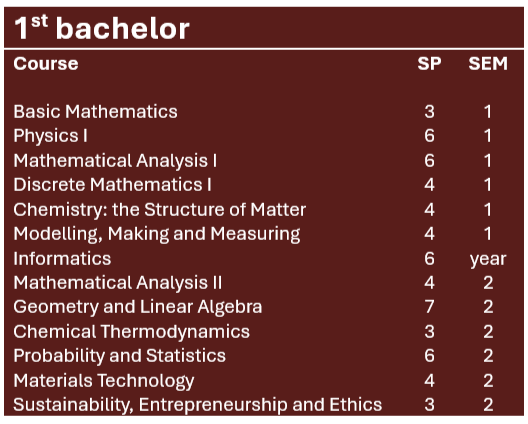
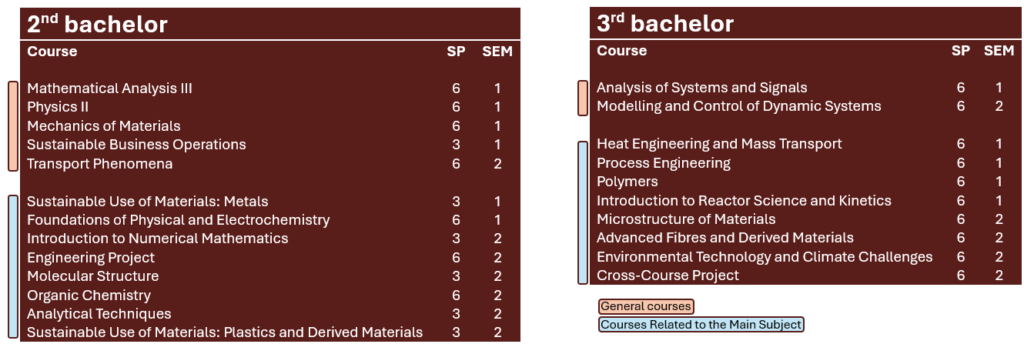
In the second year of the bachelor you choose your first specialisation track, in our case, chemical technology and materials science. During the second and third bachelor, you will build further on the engineering foundations while gaining in-depth knowledge in your chosen field, gradually discovering the different disciplines that MaChT represents.
What?
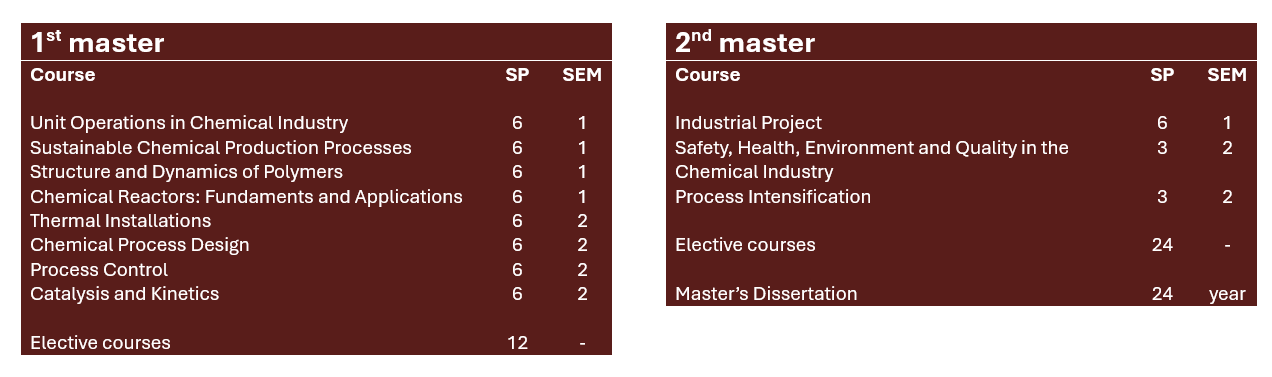
Starting from a fundamental understanding of the reaction itself, the transport phenomena and physico-chemical properties, production processes are designed, constructed and optimised. The scope of the Chemical Engineering programme ranges from the micro-scale of the chemical reaction, and the mesoscale of the reactor and separation units to the macro scale of the entire process. Through electives, our students are given the chance to tailor the curriculum to their interests, either by means of a broadening or a deepening scope. Course units are either taught by recognised researchers in their field or by guest lecturers from the industry, introducing the necessary practical insights, particularly in chemical process design and process safety
Structure
The Master of Science in Chemical Engineering comprises two years (120 ECTS). General mandatory course units (72 ECTS) focus on the key aspects of the programme, such as: Chemical Reactors - Chemical Kinetics - Unit Operations - Chemical Process Design - Polymer Reaction Engineering - Process Safety and Control. Elective course units of a deepening and broadening nature (36 ECTS) allow the students to tailor their curriculum to their own interests. Work placements (both in academia as well as in industry) can be recognized as an elective. Pending approval by the Programme Committee, any course unit available in Ghent University’s education portfolio can be taken as an elective. The Master’s dissertation (24 ECTS) concludes the programme and exposes the student to the ongoing research and innovation at Ghent University
Labour market
As a Chemical Engineering graduate, you typically find employment in the chemical process industry. In addition, there are various career opportunities in the polymer, textile, food, pharmaceutical and environmental sanitation industry, where chemical transformations are implemented in the manufacturing process. Our graduates typically supervise a team responsible for (chemical) production and focuses on the improvement and innovation of processes and products. Other opportunities arise in engineering companies where you will be responsible for the design, construction and start-up of new production units. Furthermore, equipment design and construction companies employ many chemical engineers. Last but not least, universities and research institutes also recruit chemical engineers for academic positions. In short, our graduates awaits a bright future in the modern, diverse and international chemical industry which is strongly anchored in (the extended vicinity of) our region.
What?
The Master of Science in Sustainable Materials Engineering aims at the study of the extraction, production, processing, properties, sustainable use and recycling of a whole range of materials. This implies (i) the description and modelling of material properties, specifically for the chemical, mechanical and thermal production and processing aspects in materials engineering, (ii) the effect of the chemical composition and processing conditions on the structure and the properties of materials in view of optimal performance and application, and, (iii) the behavior, durability and degradation of materials in different environmental conditions. Dealing with the limited resource availability worldwide in a sustainable way is an important objective of the programme. These concepts are applied to various important materials: metals, polymers, textiles, and composites
Structure
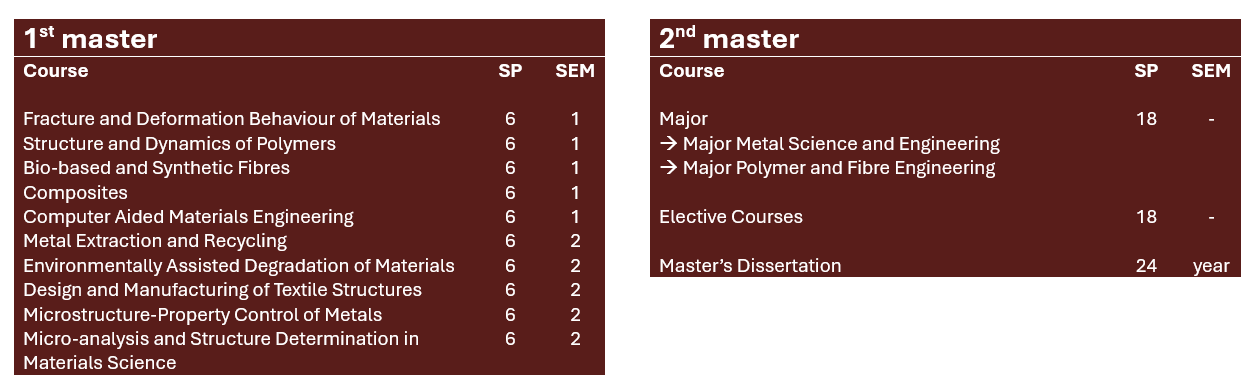
The curriculum comprises four parts: (i) general compulsory course units, (ii) a choice between two majors to allow specialisation in a particular field of materials engineering, (iii) elective course units, and, (iv) the Master’s dissertation. The general compulsory course units focus on material sciences, specific material types, material structure/property relations and performance analysis, and production and processing technology. These course units lay the foundation for every materials engineer. The course units are also in line with the specific (regional) sectors such as the metallurgical and the plastics/textile industry. Throughout the course units, the aspects of sustainability are addressed and new technologies are discussed, allowing future engineers to develop more eco-friendly materials and processes. Among other things, we cover and/or foster:
- the development of innovative and light-weight materials used in e.g. constructions and vehicles where stringent safety requirements apply;
- the optimisation of chemical composition and processing of metals and polymers, and, an understanding of fundamental properties of the different materials, how they relate to the material structure and how these are affected during processing;
- the simulation of material properties and subsequent interpretation of the outcome of such simulations;
- an understanding of why a material degrades with time and due to environmental influences, and how surface engineering can increase its life span;
- how to process metals from secondary sources (such as scrap or e-waste) that are just as high-performing as metals produced from primary raw materials (ores);
- etc.
In the second year, students can choose between two majors to specialise further in one material group. The Metal Science and Engineering major focuses on metals with an emphasis on atomistic and microscopic understanding, modelling of microstructural processes and material properties and a further deep-dive into sustainable metal processing. The Polymer and Fibre Engineering major focuses on polymers and textiles with an emphasis on polymer processing and recycling technologies, colouring and finishing of fibres and a deep-dive into technical and functional textiles. The elective course units offer the possibility to concentrate further on specific topics such as ecology, nanotechnology, smart materials, etc. The curriculum also leaves room for a minor (18 credits), which students can choose as part of the electives: Operations Management, Environment and Sustainable Development and Automotive Production Engineering. The electives also offer students the option of a research work placement or an industrial work placement at a company. This is a good way to get to know the different types of material engineers and their day-to-day job content. Finally, there is the Master’s dissertation. Since the programme is strongly embedded in different materials research groups at our the faculty, you will also get a taste of the ongoing research activities in the discipline as well as get updated on state-of-theart topics. The best way to illustrate this is our extensive list of dissertation topics, ranging from experimental to modelling work and from metals to textiles, all of them in line with the current research activities. The Master’s dissertation stimulates independent and critical thinking and enhances project management skills.
Labour market
Masters in Sustainable Materials Engineering – like all other engineers– have a wide range of career possibilities. The demand for engineers exceeds the number of graduates available, including material science engineers. Graduates have careers in the industry, public service or scientific research. Fundamental and applied scientific research focuses on the properties, the behaviour, the processing and the production of different types of materials, such as metals, synthetic materials, ceramics, composites and ‘new’ materials. Others analyse and optimise existing or new production and processing methods. Researchers can work at academic and industrial research centres. In the industry, material science engineers have technical, commercial or management positions. The innovation and development of advanced products for new markets and the application of new technologies are essential for a healthy industry. Traditional and new important industrial sectors for experts in materials are: the metal industry, the polymer and textile industry, both production and processing such as recycling of metals or polymers, assembly plants, component producers, chemical companies (e.g. corrosion or process engineer and material selection), machine manufacturers, microelectronics companies (semiconductors), supervisory bodies and centres of expertise (material properties and study of insurance claims), packaging, transport (e.g. composites), pharmacy, agriculture, etc. Material science engineers often work along mechanical engineers, architects or chemists but have a specific complementary profile which is of vital importance in the implementation of engineering projects. They hold leading positions in the development, production and sales of high-value materials